Bima Feed Website
Grapiku developed the bimafeed.com website to serve as a company profile and to boost cattle feed sales to 1,000 metric tons per month through a dealer network.
Client
 Bima Feed
Service
Website Development
Industry
—
Grapiku developed the bimafeed.com website to serve as a company profile and to boost cattle feed sales to 1,000 metric tons per month through a dealer network.
Client
Bima FeedService
Industry
Bima Feed is a brand of ruminant livestock feed produced by UD Munir Jaya for cattle, goats, sheep, and water buffalo. Its products are designed to accelerate livestock growth, improve carcass quality, and support farm productivity.
Bima Feed originated from Munir’s experience as a livestock farmer in Tuban who struggled to obtain local feed. He then developed a concentrate feed for his own livestock and began marketing it under the Bima Feed brand in 2017.
As a brand launched in 2017, Bima Feed needs to accelerate its market penetration and build trust among well-established animal feed companies.
Bima Feed requires digital channels to showcase its product advantages, provide educational content tailored to farmers’ needs, and attract potential agents to join its distribution network across various regions.
Primary Objective
To build a brand marketing website to increase awareness and expand sales of Bima Feed through an agency system.
However, the heavy nature of the product (50 kg per bag) makes direct sales from the factory to farmers less efficient, so digitalization must both build demand and strengthen distribution through agents.

Launched in 2017, Bima Feed needs to build awareness and trust among consumers who are already familiar with other animal feed brands.

Farmers need clear information about a product’s intended use, composition, nutritional content, and instructions for use before deciding to purchase it.

Bima Feed needs a system to attract potential agents while helping farmers find the nearest place to make purchases.

A product weighing 50 kg means that the cost of shipping it directly from the factory could potentially be higher than the product’s price.
Grapiku developed bimafeed.com as both a company profile and a brand marketing website serving two primary audiences. Farmers gain access to product information, educational resources, consultation services, and the locations of nearby agents. Prospective agents receive information on agency opportunities and a channel to connect directly with Bima Feed.
The website does not direct all purchases directly to the factory. Demand is built through education and product awareness, while purchasing options are expanded through agents in various regions. This strategy allows brand awareness and the distribution network to grow simultaneously.
Aligning business goals, user targets, positioning, and the key requirements for the Bima Feed website. This phase also includes identifying communication challenges, feature priorities, and project KPIs.
Analysis of direct and indirect competitors to map out visual benchmarks, information architecture, features, positioning, and opportunities for Bima Feed to differentiate itself.
Designing the information architecture based on the user journey for farmers (B2C) as well as distributors and agents (B2B).
Organize the content into a wireframe. Focus on navigation, the information hierarchy of product pages and articles, and the agency landing page.
Implement the visual system in accordance with the brand guidelines to ensure consistent UI component design across all pages.
Development of a dynamic website using a custom WordPress setup. This includes product catalog development, content development, integration, and efficient code optimization.
Comprehensive testing across devices and browsers. Migration to the bimafeed.com domain, integration of analytics, security, and basic SEO. Plus, a training session for the Bima Feed team on self-managed content management.
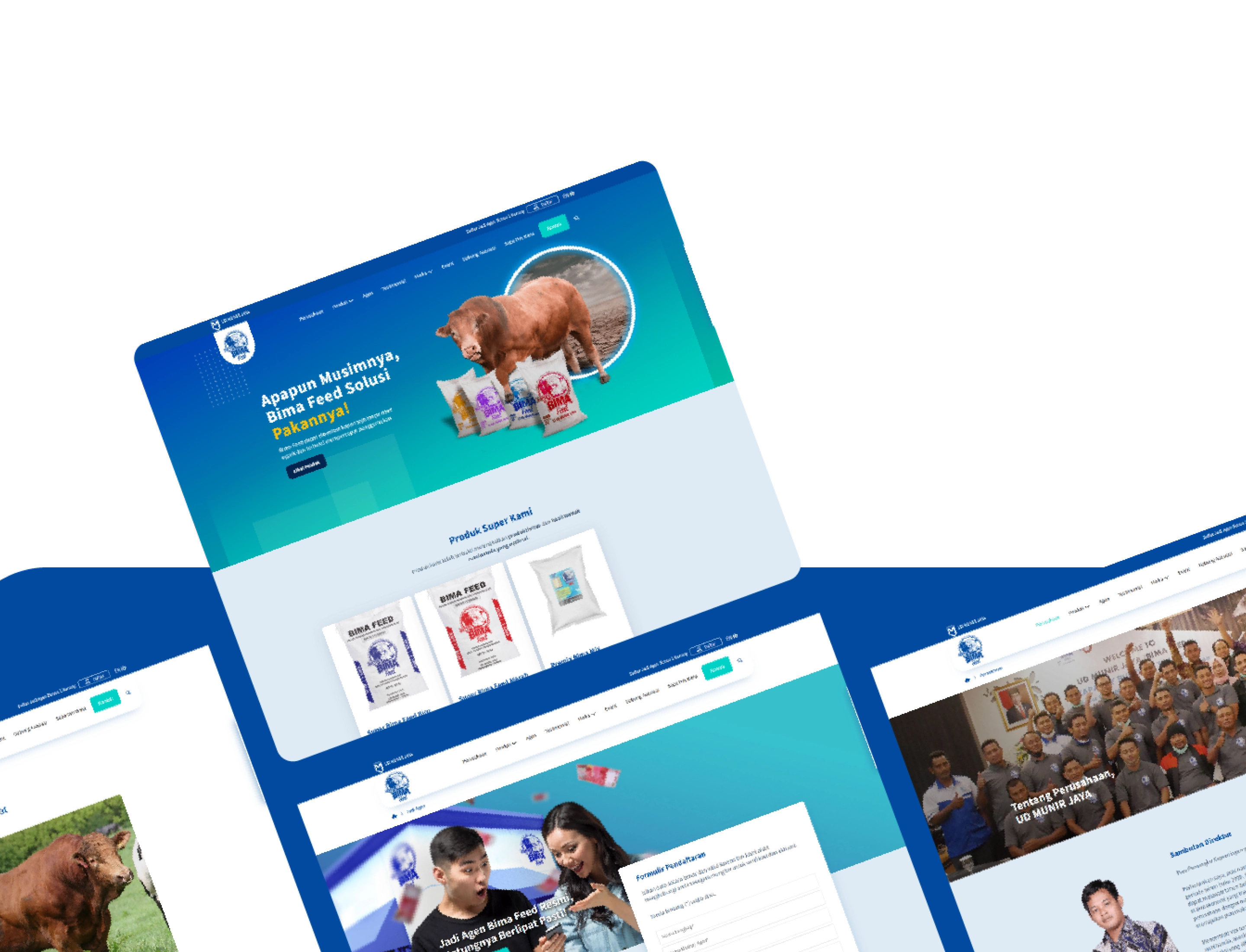
The website’s design was developed in line with Bima Feed’s visual identity to create a professional yet approachable image for livestock farmers. The company profile, brand journey, production capacity, and product advantages were highlighted to build trust in Bima Feed.
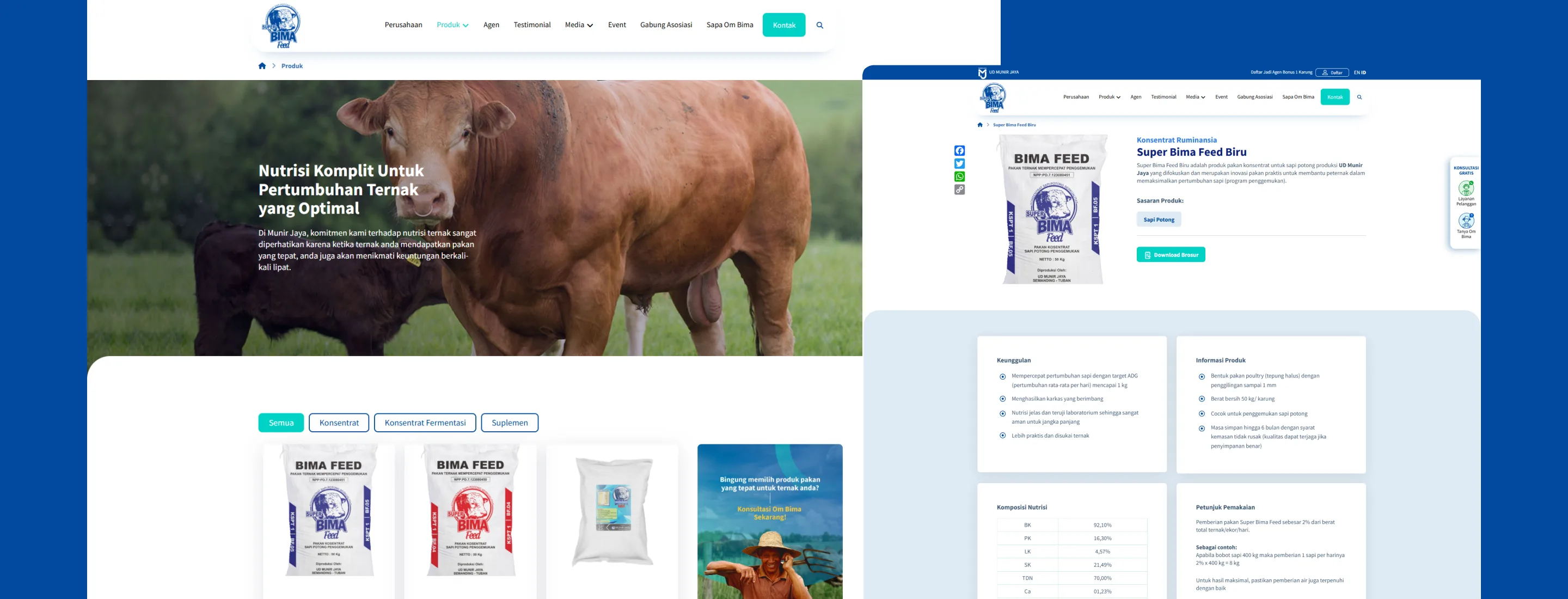
Research shows that farmers focus on product objectives, composition, and nutritional content. Therefore, the product pages are designed to be concise, featuring brief descriptions, nutrition tables, benefits, and easy-to-understand usage instructions.
The consultation and order buttons remain visible as the page is scrolled so that farmers can contact Bima Feed immediately after learning about the product.
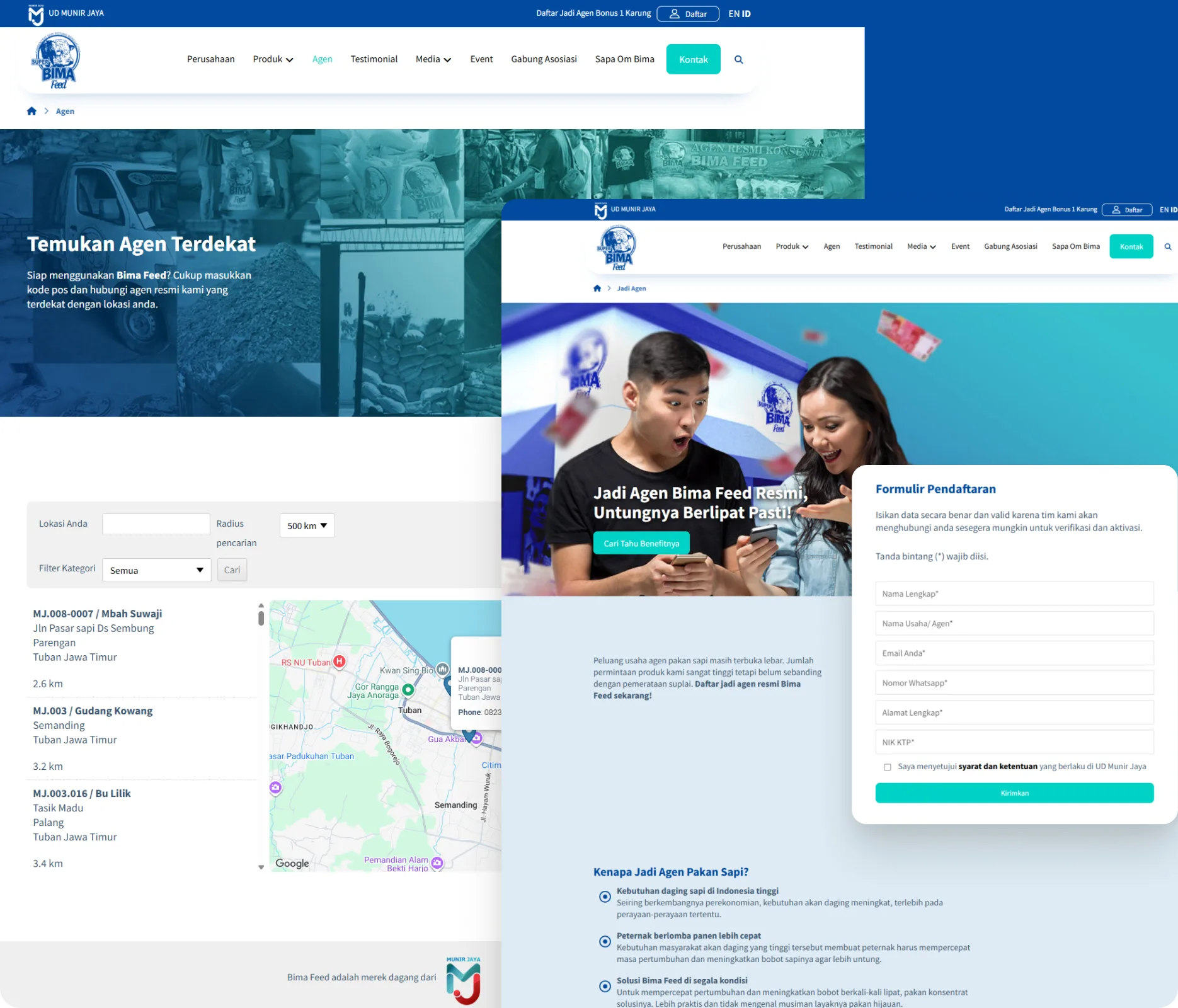
The agency system was developed to serve two purposes: to help farmers find products and to recruit new agents to expand Bima Feed’s distribution network.
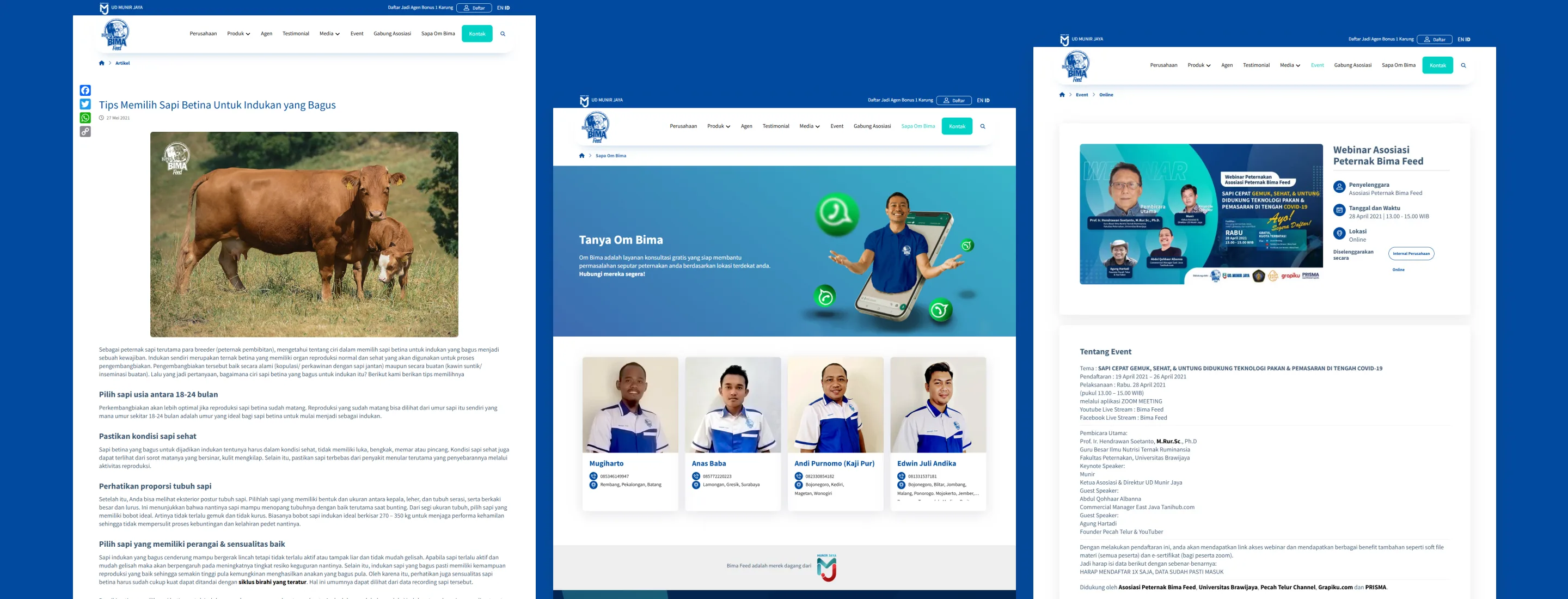
The website was developed as a space for learning and interaction that brings Bima Feed closer to livestock farmers, not merely as a product promotion channel. Additionally, this ecosystem serves as the spearhead of Bima Feed’s visibility on search engines and social media.
Bima Library
A curated collection of livestock articles designed to help farmers learn livestock management independently.
Ask Om Bima
A consultation channel that connects farmers with livestock experts based on their nearest region.
Bima Events
An information portal for webinars, farmer meetups, and internal and external activities involving the farming community.
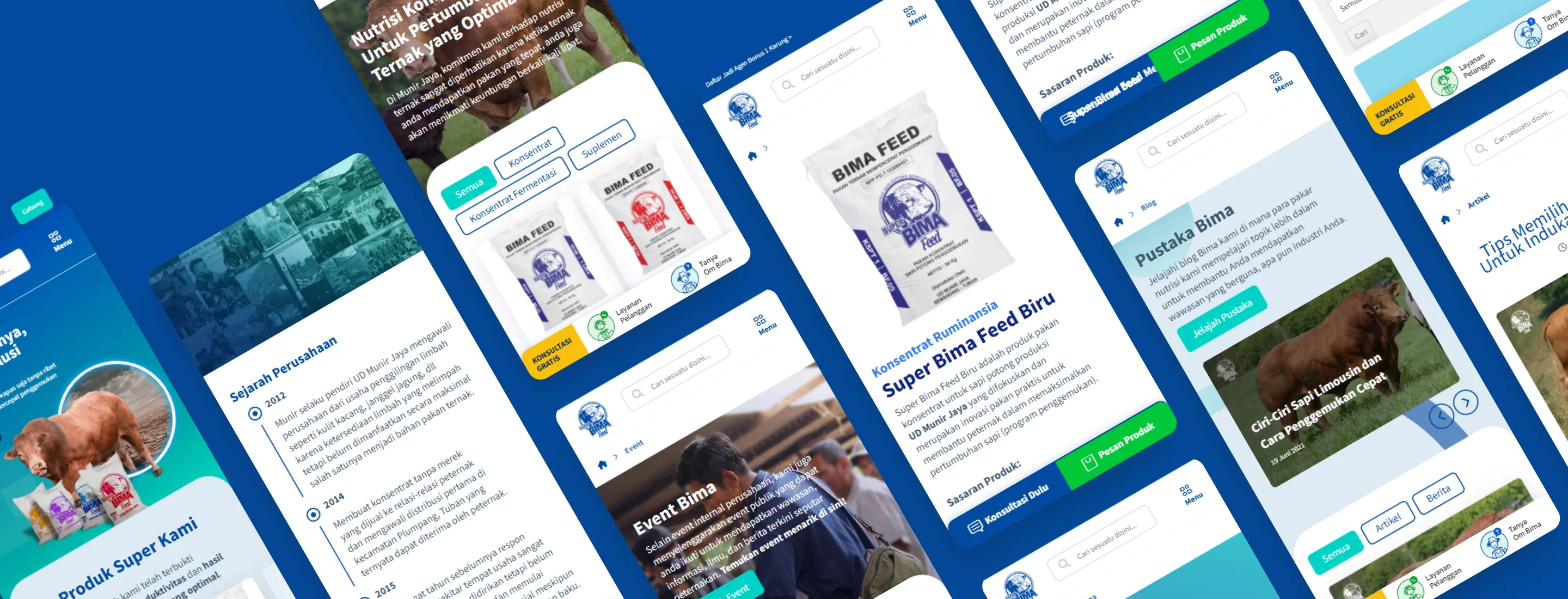
The website is designed to be responsive for the majority of farmers who access information via smartphones. The layout, content hierarchy, images, and interactive elements are optimized to ensure ease of use across various smartphone screen sizes and connection conditions particularly in rural and mountainous areas.
The website supports marketing efforts and boosts sales conversions to over 1,000 metric tons per month.
The registration landing page successfully converted interest in becoming an agent into a database of leads that can be followed up on.
A floating CTA on every page shortens the path from content exploration to consultation and booking.

Websites Launched
Monthly Active Users
Increase in Interaction Time

Organic Traffic Growth
Ready-to-Use Calculator
Targeted Message Conversion